Sky

Sky

Saturday, March 28, 2015

March 15th 2015: Swakopmund to Mowani Mountain Camp

The timing for the second day was pretty much the same as the previous, with the 10:00 objective to be on the road. As I had been planning travel times of no more than 6 hours, I wanted to be sure to arrive no later than 16:00 at our destinations. This would allow for ample time to settle in and relax a bit, and avoid at all costs driving at dusk.

With our stomachs feeling fine, we filled up with a big breakfast and then went to see if there was any news from Avis. As there was nothing, the car was loaded and we set off along the Skeleton Coast.


This area is quite well known for its rugged and very dangerous coast, littered with shipwrecks. It is barren and flat, often subject to fogs rolling in, and this morning was no exception. No matter, the fog was not very thick, and with the sun fully up, the lingering humidity was being burnt away. That was when we came across one of the more recent shipwrecks that was very visible from the road.


Clearly it has become a popular spot as they have even prepared a road out on the beach to get closer to the wreck. We were not alone taking pictures this morning, which as it turns out was a good thing. With the local hawkers busy with the other group of cars, we were able to grab some shots and quickly get back on the road.

A little bit further on we reached what is pretty much the last village on this coast until you then reach Angola: Henties Bay. If you continue on the Skeleton Coast from here, the road becomes very rough, and eventually only passable with a proper 4x4 vehicle. We were not to attempt this, and instead took a 90° turn inland towards Uis.

Here the road heads in a very straight line straight in to the desert, and as you leave the coast the temperature quickly goes up to nearly 40°. Although it is a gravel road, it is in good condition, but it can sometimes be difficult to tell where the roadside ends and the desert begins. As we have gotten used to, there is very little traffic, but we do meet some very courageous motorcycle riders toughing it out in the heat and the dust. I bet they will be glad when they finally reach Swakopmund!


There is not much wildlife in this very arid area, but we do come across a group of ostriches at some point, before we finally reach the small village of Uis. I haven’t pointed this out earlier, but one thing to be careful of when driving in Namibia is to ALWAYS fill up your tank when you see a service station, and there happens to be one in Uis. I am not overly concerned about the fuel though, as our car has an autonomy of some 800km, and I know that none of my planned routes exceed 400km by much, but still it is always better to be safe than sorry.


So, we pull in to the station and fill the car with diesel. Since there is also a small rest area with some cover, we take the opportunity to have our lunch, consisting of a ham sandwich and a banana. Oh, and some more water! It is very hot at this point, and as soon as you switch of the AC in the car, or step outside, you immediately start sweating profusely. Because of the heat we decide not to linger, and are soon back on the road heading in the direction of Khorixas.

On the way we see in the distance the Mount Brandberg with the White Lady paintings. These are some primitive rock paintings, that we agree not to go and visit as it would require a strenuous hike in the sweltering heat. Besides, I am eager to get to the Mowani Lodge in order to settle down with a nice cool drink.


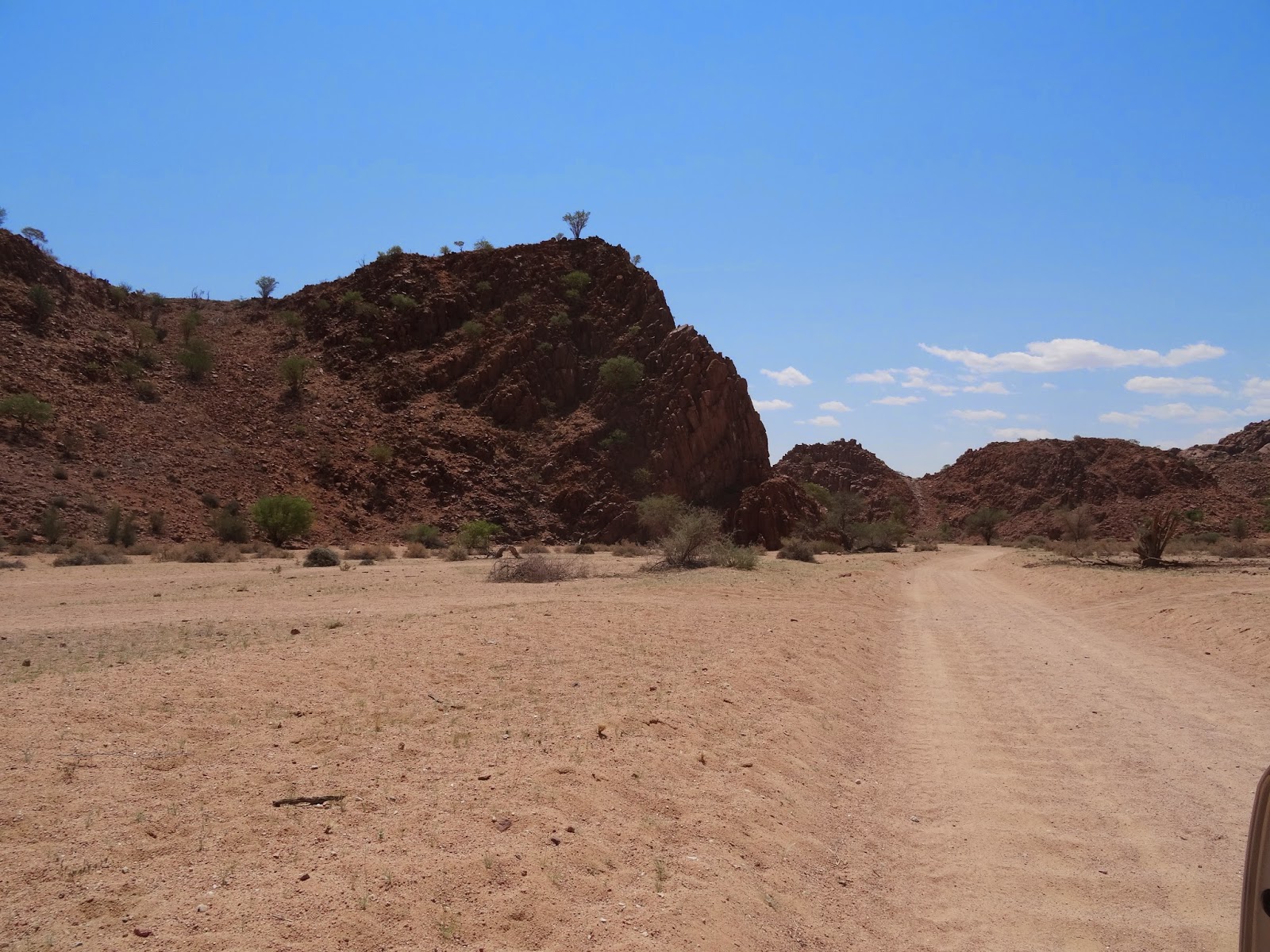
We are on the C35 road, and normally should continue on this one for a while longer, but our TomTom tells us to turn off on the D2319. Checking the map, I see that this may be a bit of a shortcut and decide to follow the advice of the GPS. It turns out to be a great decision as although this part of road is very isolated, it brings us through an amazing area of red rock formations in the desert which is inhabited by desert elephants. We do not actually get to see the elephants, but the scenery is simply stunning, and we just have to stop for a while to take it all in, and take some photos.


We go through a settlement called Sorris-Sorris, before reaching again the C35, and then turning on to the D2612 which will take us to the Mowani Lodge. This area is called Damaraland, and is one of the more scenic areas of Namibia, and in my opinion of the world. The red sand, littered with red rock formations is so pristine it almost looks like something out of a movie set. The place looks a little bit like Monument Valley, although the peaks are not quite as tall as they are in Arizona. I am reminded a bit of Wadi Rum in Jordan as well, a place I knew well as a kid, and feel right at home.


Soon we arrive at the Mowani Lodge, and get settled in our permanent tent cabin. There is no AC, and so it is quite hot, and although we are a bit concerned about how it will be at night, the view from our room makes it all worthwhile. I think to myself that I could not have chosen a better place to end the first half-century of my life.


The lodge has a swimming pool, and we figure this is the best way to cool down and relax. At the pool we meet up with a couple that have just arrived from Etosha, and so we talk a bit about what they saw while there. It turns out there seems to be loads of leopards in the eastern part of the Park! That certainly sounds promising.

Strange rock paintings?

We settle in for sundowners, with a stunning view over the vast arid plains, and the setting sun in the distance. The red sand and rock formations of the area only serve to make the sight even more impressive, and we witness together one of the most beautiful sunsets one can possibly see.


Dinner is served in the lodge’s restaurant, and is a nice piece of tournedos. Unfortunately it is a bit over-cooked, probably a result of the German influence on the cooking. We had asked for rare, but the meat is more like well-done. This is something to remember for the future so that we ensure to ask for proper rare steaks!


No internet or phone connection is bliss, and we end up going to bed unusually early. Tomorrow is my birthday and the day we are set to arrive in Etosha. This turns out to be the perfect relaxing stop on the journey before the excitement begins, and more than worth it to make the effort of driving here.

The sun setting on my 50 years...


March 14th 2015: Windhoek to Swakopmund

It was certainly nice to get a good night’s sleep after the long trip the previous day, and the bed at the Windhoek Hilton was just what we needed. Still, as we had a lot of ground to cover, and I was a little bit uncertain what the roads would actually be like, we needed to wake up early so as to get going as quickly as possible.

I had set my objective at being on the road by 10:00 latest, and after a big breakfast and a quick stop to a supermarket for the basic necessities for the trip, we did indeed pull out of the parking lot at 10:00.

Leaving Windhoek was really very uneventful, and rapidly disposed of. No traffic jams, and given the size of the place we soon found ourselves on the C26 heading towards Walvis Bay. The road was properly paved the first few kilometres, but it was not long before this ended, and the gravel road took over. This would be the sort of roads we would be experiencing for most of the trip, and so I began by taking it easy so as to get used to the slightly slippery surface.


I must say that the quality of the gravel road was excellent, with little to no pot-holes, and only the occasional wash-board effect. However, one must be careful coming in to corners and braking as the feel is similar to that of driving on snow. I suppose the advantage was that driving around 70 to 80kmh we had more time to check out the scenery.


And what a scenery!! You are immediately struck by the beauty of the surroundings, and you can really profit from it as you are very much alone. During our traverse to Walvis Bay I don’t think we met more than five cars, and not a single over-take. But back to the scenery. It keeps changing all the time, becoming more and more like a desert the more west we got. At one point, a bit less than half way across, the terrain suddenly change as you go over a mountain pass. It was perfectly dry during our passage, but I can imagine that this would be quite exciting during heavy rain being on narrow gravel roads with steep ravines just to your side. But the sheer beauty of it all forces you to drive slowly so as to take it all in, and you simply have to stop a few times for some obligatory photo shoots.


Stepping out of the air-conditioned car you are obviously struck by the temperature. It was hot, and would get hotter the more we penetrated in to the Namib Desert after the mountain pass. Eventually we pulled over in to a dry river bed with a couple of trees providing a semblance of shade in order to eat a quick lunch. It was not like we were really hungry, but you do need to eat. And drink. Lots of water.


Since the start, Myriam was already in full wildlife spotting mode, and we did a number of stops in order to take pictures of the first birds (a pygmy falcon was first), first antelopes (kudu) and monkeys. Funnily enough, those monkeys were about the only ones we would see on the whole trip, but more about that later.


After the mountains, the road would get more and more straight and flat. With the heat and draught having packed the surface, it was more like driving on a smooth concrete road, and the speed would gradually increase to over 100kmh. It was by this time that Dune 7 came in to view, and the coast was very close.


We pulled over to get some good photos of this imposing sand dune, among the tallest in the world, and we were struck by the cool temperature upon exiting the car. With the cold Atlantic Ocean of the coast, the temperature had easily dropped by half since just a few kilometres back, and it was suddenly very pleasant outside. You could see the fog blowing in just down the road, and we decided to keep going to our destination.


Zipping through Walvis Bay showed a fairly boring industrial town, but we soon then pulled in to Swakopmund. This is a pretty strange place due to its very German heritage. The buildings look like German buildings from 100 years ago, and the place is very quiet. Our hotel for the night was to be the Swakopmund Hotel, which is a former train station that has been turned in to a hotel and casino. It is a quite beautiful building, looking something like a big meringue in its light yellow paint with white corners.

We completed the check-in, and completely emptied the car. Not so much for fear of theft, but more because we were expecting Avis to come and replace the car the following morning. This was to become somewhat of a recurring theme until the end of the trip, and even though the car never actually was replaced, I suppose it was not a bad thing to not leave stuff in the car overnight. That said, we never noticed any signs of rampant crime, and felt very safe all through the trip. Granted, there is the common pick-pocketing, but nothing ordinary travel vigilance will help avoid.


Pulling on long trousers, and getting our jackets out, we set out for dinner. We were struck by the most stunning sunset, and had to take some photos. This was far from our last beautiful sunset though. It quickly became clear that eating in Namibia would be a little bit problematic due to the German heritage. We are not fans of heavy meals with loads of cream and cheese, but clearly all restaurants were German. We settle for a seafood place hoping to be able to find something decent. I knew that over the rest of the stay fish would not be easy to come by, and with the prospect of eating nothing but meat for ten days, wanted to at least try and vary the menu at this coastal town.

Their seafood platter sounded tempting; under the condition that everything was not deep fried. In the past we have had some bad experiences along those lines, especially in New Orleans, but also in Australia. However here, most would be grilled, and there were even live oysters served! Done deal, the platter for two was ordered.

It turned out huge, and really far too much food. Still, the oysters were fat and delicious, the grilled crayfish and shrimps excellent, and even the fried fish was good. But there was no way we would be able to finish everything, and so it was with regret we ended up leaving most of the fish, having polished of all of the seafood.


After a fairly chilly walk back to the hotel, we crashed in to our bed with our minds full of the images of the day (and a slight concern for our stomachs since we had now started on the malaria medicine in preparation for Etosha). 

March 12th – 13th 2015: Travelling to Namibia

Our travel to Windhoek would be a fairly long one, and began on Thursday March 12th. As I took the day off from work, and our flight from Geneva was only at 20:50, we obviously had a lot of time to prepare everything. The thing is though you can never have too much time! Still, it was one of the most relaxing trip starts we have had, and to top things off, my brother came to pick us up at 18:00 to go to the airport.

Yeah, I bet you are thinking that getting picked up at 18:00 is a bit too early for a flight basically three hours later, but since the Geneva car show was on you never know what the traffic is going to be like. As it turns out, there were no problems, and we arrived well in advance of our flight. On top of this, the airport was strangely empty and so the check-in was very swift.

Getting to the standard Tax-Free cigarette purchase, we walked past a stand for Villars chocolates, which reminded us we had not bought any of their fabulous dark chocolate with hazelnuts for our trip. So, after chasing down a sales person, we picked up a few of those for those relaxing moments in the evening.

As we were both starving, we headed for the lounge and some lousy pasta with Mexican meatballs. If it is one thing you can be certain of, it is that the Swiss Business lounge in Geneva is not the place to have dinner. Given that we would be indulging in a late dinner on the Johannesburg flight, we just needed something to help us wait.

It is always nice to settle in for a long flight. I am always pretty eager to get on board, and as usual, we were one of the first persons to board. This way you can prepare all your things and get really comfortable before the take off. We were getting really hungry by now though, and it was without surprise that we found the menu to have a fairly poor selection. In the end, we both decided on having the perch, as they confirmed they could serve it without the butter sauce.

After take-off, they were pretty slow in getting the service going though. It seems to me that they must be reducing the staff in the business section, because it is taking longer and longer for them to get the service organized. They were pleasant enough though, and in spite of first bringing Myriam her perch with the sauce, they quickly replaced this.

We both slept really well after the dinner, and I got a good 5.5 hours sleep. The flight was actually shorter than I expected it, but I guess that just means we will sleep even better the first night in Namibia.

Johannesburg was pretty uneventful. The airport has been considerably improved since we were last here, and there was a good selection of shops. So, we first set out to find a safari hat for Myriam, and although we did find the perfect one, they did not have the right size. We will just have to try again later in our trip. After that we headed off to the business lounge, which surprising also had a smoking lounge in it! Yeah, well us smokers are having more and more trouble finding places to smoke in peace, so this was a nice surprise!

The last leg of our trip was a pretty quick and comfortable 2 hour flight to Windhoek. Getting off the plane, we then had to walk to the terminal in the scorching sun! I didn't mind at all, and it was a chance to see the difference between 35° in Singapore with 100% humidity and the dry 35° in Windhoek. Had we been in Singapore we would have been soaked arriving at the terminal!

Finally we proceeded to pick up our car. There seemed to be some issue with it, and when we finally got outside we were told that the problem was that our car needed to be serviced soon, and so we would have to change it during the course of our trip! Not really what you want to have to do, but what can you do. No matter, our car was a really nice Toyota Fortuner, and after a long discussion as well as an explanation about the car, we were finally rolling towards Windhoek. Oh, the very friendly Avis guy told us that people had spotted giraffes on the way to Windhoek, so you can bet Myriam had her eyes wide open the whole way, but no luck.


Windhoek is the biggest city in Namibia, and it is probably smaller than Nyon! The hotel was very easy to find, but then it turned out that in spite of requesting a smoking room they obviously had not taken notice of this. Luckily there was one left, and so all it then took was sorting out the key cards to get them to work in the elevator, and we were finally settled in our room for the night.


We then spent the evening getting our gear in order for the coming days, trying to be as practical as possible. 

Namibia 2015

Having wanted to go for a number of years, and the fact that it has been 12 years since we were last in Africa, we decided to do an adventure in Namibia this year in connection with my 50th birthday. Having spent quite some time organizing the trip, I figured I would now properly document it as well. So here will be some daily reports of our adventures….


Friday, March 6, 2015

Whistleblowers

For anybody with a connection to the financial world, it would have been impossible to miss the scandal regarding HSBC Switzerland recently. Although not really a new development, it is perhaps since a month now that the SwissLeaks has become public knowledge with the data stolen by an IT staff member of HSBC back in 2008 has been made public. The data provided is rather complete, containing full details of some 100’000 clients but also much of the call and meeting reports registered by Relationship Managers for the contact they had with these clients. The media has divulged some of this, mostly trying to single out famous names in an attempt to further discredit the bank as well as the famous clients. The fact that many of those names actually had not done anything wrong, other than seeking financial advice from a renowned private bank, is something which has totally been omitted from the press.

No matter. What I wanted to write about today is how the public and the governments are seeing whistle blowers differently depending on the information they are divulging. There is a considerable hypocrisy going on here, and unfortunately not many people are picking up on this due to the way the media in general is presenting things. We are all very manipulated by the media, even if we don’t realize it.

For starters, we have whistle blowers such as Hervé Falciani and Bradley Birkenfeld. Falciani, the IT employee behind the leak from HSBC, is being heralded as a hero by much of the world’s media as well as many governments. Birkenfeld was ultimately rewarded with USD 104 million for his involvement in denouncing the illicit practices of UBS, that evil Swiss bank.  There are some other examples such as Heinrich Kieber who received EUR 4.2 million from German for the files he stole from a bank in Liechtenstein.

All of these whistle blowers have one thing in common; they have been attacking Swiss and Liechtenstein banks as well as wealthy individuals. Governments are putting these people on a podium because they dared to speak out against those evil banks. The fact that much of the information provided is actually that of clients having fully legitimate and declared assets with banks that were chosen because of their professional expertise as well as confidentiality is beside the point.

At the same time, we have some other whistle blowers that are instead being treated as criminals and traitors, having to live life in hiding or in prison. These are people like Julian Assange, Edward Snowden and Bradley Manning. Instead of receiving the same sort of heroes greeting, they are chased as dangerous criminals or as is the case for Manning serving 35 years in prison. What do they have in common? Well, these have all attacked governments and their illicit practices.

We can conclude here that the same country that gave Birkenfeld USD 104 million for his whistleblowing has sentenced Manning to 35 years in prison for his. So, if you are going to be a whistleblower, be careful about who you are blowing the whistle on. The fact that this sort of defeats the purpose of whistleblowers I suppose is beside the point. At least in the mind of some…


Wednesday, February 25, 2015

WSBK

Readers of this blog should know that I have a passion for cars, like the Mini, and obviously motorcycles. This passion is not limited to the actual machines, but also racing. For a very long time I was a hard-core fan of Formula 1 racing, but unfortunately money ended up corrupting this sport to an extent that I simply lost interest. Luckily there is still motorcycle racing, a motor-sport that has suffered as well from being corrupted by money, but that has nevertheless been able to maintain a level of pure passion through the mindset of the riders. It takes something special to become a world class motorcycle racer, and for having known some of them, and been a fan of many more, my passion for what they do remains intact.

It is with considerable anticipation then that I am able to tune in to the first major race of the year. Traditionally the World Superbike Championship, or WSBK, kicks off at Philip Island in late February. Apart from being eager to finally get to watch some motorcycle racing after the long winter break, this track is by far my favorite for several reasons. For starters, most racers will agree that it is one of the last pure motorcycle tracks available, with fast sweeping corners almost all the way. It is an old-school track, and only the best really get to the top here. Because of its layout, the racing is always good too.

The other main reason I so love this track is that I know it intimately for having ridden here myself. Roughly ten years ago, I went there to partake in the superbike school in an effort to improve my own riding skills, and to experience the thrill of racing around a proper track. After spending two full days completing the first two levels of the superbike school, I then came back to the track a couple of years later to complete the remaining two levels of the school so as to be able to comfortably go around the track at speed, emulating those racing heroes of mine. Having learnt all the intricacies of the track, I have been able to better understand what it means to race there, and as I sit comfortably in front of my TV and watch a race there, I know how it feels to come in to Doohan corner at full speed, then flick the bike over to the other side to fly through the double apex corner of the Southern Loop. Accelerating hard then up through the recently baptized Stoner corner, where the top racers have the rear of the bike slide out while going 230kmh, and then stand on the brakes to slow down enough to get through the Honda hairpin. Exiting the hairpin, there is a short straight to get some speed, and then you hit Siberia to turn left up through the sweeping Hayshed where again you are nearly flat out but leaning over as far as you can to make it through. Next you go up over Lukey Heights as you turn right. As you pass the blind crest, you again sit up with your heart in your throat because the MG hairpin is suddenly right there and it is time to flick the bike to your right as hard as you can. From here on there is a wonderful succession of left hand corners that gradually open up and lead you back to the start/finish straight and time to fully open up the bike.

I know the track by heart, and can race around it in my mind, timing myself to pretty much the same lap times I can accomplish on a 600 Supersport bike. Sometimes, to relax, I close my eyes and let my mind go there, doing lap after lap until I fall asleep. I can feel my knees touching down in the corners, and my body being pressed on to the bike as I try to accelerate harder in a corner. I always lose my nerve as I approach Doohan, and slow down too much, kicking myself when I am finally in the corner as I know I could have gone faster. It is just the sloping hill leading towards the Bass Straight that scares me each and every time, but it helps me then take the Southern Loop with even more rage. Charging up through Stoner curve is always thrilling as this is a very fast one, but it is also humbling as here the black marks left by the racers tells you just how much they are sliding while going through, and so suddenly you feel like you are crawling in comparison. The Honda hairpin is a bit of a mixed bag; sometimes I get it spot on and it feels great, whereas other times you get the fear of going too fast before leaning in, causing you to get back on the brakes just a little bit more. You don’t actually need that extra brake, but by now your mind is playing tricks on you so there is no way you manage to get through smoothly. But you get the picture, if I close my eyes I am there!

So, this last weekend the WSBK championship for 2015 kicked off. It was with extra anticipation that I sat down to watch the two races though for two main reasons. First of all, a good friend of mine has worked through the winter in getting an all-new set of rules out resulting in perhaps slightly slower lap times but also an evening out of the performance of the various bikes. Secondly most of the riders have been switched around on the various bikes. Yes, Sykes is still on a Kawasaki, but he has been joined there by Johnny Rea after a long stint with Honda. Guintoli has taken his No.1 from Aprilia and placed it on the Honda vacated by Johnny. Leon Haslam has moved to Aprilia and Chaz Davies is now on a Ducati. Oh and retired legend Troy Bayliss was back with a wild card for the first round at nearly 46 years old! That makes him older than I was last time I rode at Philip Island!

There have been times in the past when I may have struggled a bit to keep my eyes open all through one of these races, but not so last Sunday! Both races were incredibly intense, with a tight group of some 7 or eight riders being very closely matched on different machinery. If we include the fact that Suzuki had dominated in practice, we then find Kawasaki, Honda, Aprilia and Ducati evenly matched. That makes for 5 different top brands with very good chances to win races and ultimately the championship, with some added entertainment from MV Agusta and EBR (yep, that stands for Eric Buell Racing!). It is a pity that BMW has pulled their factory support as I have no doubt they would be equally in the mix as well.

The rule changes certainly seem to be a success, for the racing was exceptional. Granted, Philip Island usually does bring good races due to its flowing layout, but the rules certainly have not messed things up. And the factory teams are up to the challenge!


Now bring on the rest…


Unions

I am always looking for an interesting piece of news to comment on, and I must say that there is never a lack of it. Finding the time to write a little blog entry it then almost becomes difficult to select which article to comment on!

Today there was one I found particularly interesting, and worthy of some comments. A Union in Switzerland has made a suggestion that Swiss telecomm companies should be required to block professional email addresses outside of working hours in order to protect the employees from stress resulting from working outside of regular hours. Well that is just brilliant, and I don’t even know where to start my comments.

Okay, first of all, it always bothers me when unions decide to impose things on employees under the premise that they know what is best for the employees. I would gladly admit that historically unions have done a lot of good in improving working conditions. Although I was not around to experience it, from what I have read it was pretty tough on the workers 150 years ago, something more akin to sweatshops in Bangladesh today. Add to that weekends, and reasonable working hours along with salaries that allow us to have a very good standard of living. Certainly all of this is not entirely thanks to unions, but over the years they have no doubt greatly contributed to making our work-life easier. Unfortunately after having seen all these improvements it seems as if they lost their way simply because there was nothing really more to do and improve. So, they began to want to get involved in the running of companies, and then voicing demands that are simply unreasonable as well as often being against what the actual employees want.

There have been many cases in recent history where a group of unions have forced their members to participate in a strike in order to push through unreasonable and economically unsustainable demands. They fully set aside all concern for the actual economic situation, and only focus on the short-term benefit of their members. A perfect example is that of a company that is struggling with their revenue due to a weakening market. At some point, the costs exceed the revenues, and so it is necessary to revise the costs so as to find a positive balance. When a job cutting plan is then proposed, the unions vehemently oppose this, first of all by having the workers go on strike so as to send a message to the management. Sure, a message is sent but at the cost of production being halted temporarily. This interruption has the effect of totally cutting revenues for a period of time, as well as sending a negative message to the clients. Some clients at this point may consider other vendors, further reducing the revenue. Finally the management is forced in to not implementing the job cutting, and things continue as they are for a while.

Six months later, the losses incurred by the company are such that they are no longer able to honor their creditors leading to the company going bankrupt and the whole staff being laid off. At this point the union steps in and criticizes the management for having run the company to the ground and claim it is their full responsibility that all these people are now unemployed. In reality, had they allowed for the 10% job reduction, not only would the company still be up and running, possibly looking in to expanding to new markets, but it is likely that a majority of those 10% laid off would have found new employment by now through the assistance offered from the management in form of outplacement services.

Back to the article of the day. There are a lot of businesses that require at least a portion of their staff to be available off regular working hours for things to work. The world does not stop at five PM on Friday. Furthermore, there are a number of people that actually appreciate the possibility to manage their workload themselves. I for one much prefer having a look at my business email a couple of times over the weekend when it is not disruptive rather than finding an overloaded inbox on Monday morning as I come to work. It makes for much more efficient Monday mornings, as well as very appreciative recipients on the other end that actually appreciate a rapid response to their queries. I am a grown adult, and am actually capable of assuming the responsibility of managing my time. I most certainly do not want a union telling me when I can or can’t work. Switching off the Blackberry myself is not that difficult, and I have the possibility to switch it back on whenever I want.